Katsuta Claims First WRC Win on African Soil — Safari Rally Kenya 2026 | World Stage Journal
RALLY🇯🇵2026-03-15
Katsuta Claims First WRC Win on African Soil — Safari Rally Kenya 2026
World Stage Journal
Time: 3:16:05.6. Alongside co-driver Aaron Johnston, Katsuta's Toyota GR Yaris Rally1 conquered the world's most demanding gravel stage
March 15, 2026, Naivasha, Kenya. Takamoto Katsuta secured his first-ever WRC career victory. In the Safari Rally Kenya — widely regarded as the toughest event in the World Rally Championship calendar — a Japanese driver conquered the African red earth, writing a moment that will remain in the memory of rally fans worldwide.
Round 3 of the 2026 WRC season, Safari Rally Kenya (March 12–15). On the gravel stages sprawling across the Naivasha lakeside region, Takamoto Katsuta drove his Toyota GR Yaris Rally1 to perfection, claiming overall victory with a time of 3:16:05.6. The moment co-driver Aaron Johnston confirmed the win on the final stage, rally fans around the world erupted.
This was Katsuta's first WRC career victory. After years as a regular Toyota Gazoo Racing driver, repeatedly climbing the podium yet unable to reach the top step, he finally broke through. The fact that this maiden win came at the Safari Rally — widely considered the most demanding event in the WRC calendar — only adds to the magnitude of the achievement.
SUBSCRIBER EXCLUSIVE
Subscriber Only: Deep Dive
■ 1. What Is Safari Rally? — The History of the World's Most Grueling Rally
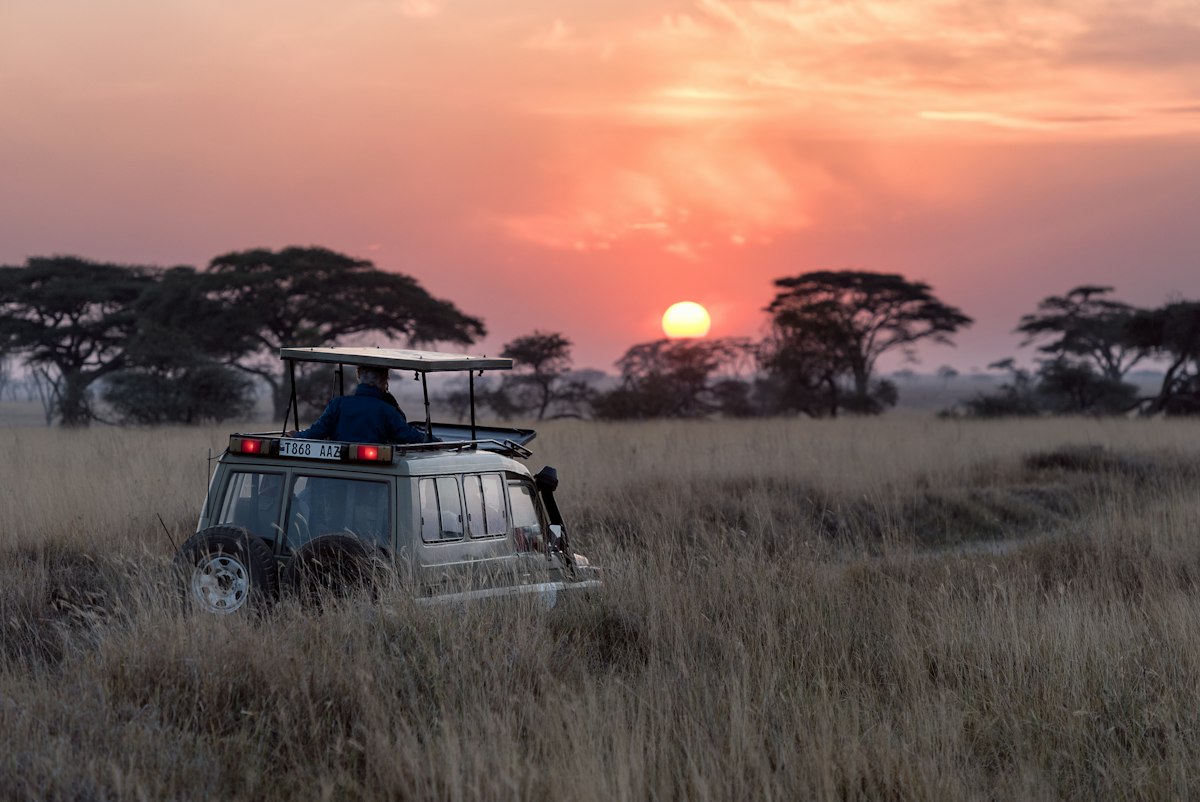
Safari Rally Kenya is a WRC round held primarily around Lake Naivasha in East Africa. The event traces its roots to 1953, when it was a true adventure rally spanning thousands of kilometers — drivers racing across land roamed by wild elephants and lions. After a long absence from the WRC calendar, it made its return in 2021, and its essential character has never changed. Laterite-red gravel, deep ruts, sudden mud sections that appear even in the dry season, and boulder-strewn mountain terrain. Tire management and suspension durability are decisive; this is a uniquely special event where simply surviving is a core strategic objective.
Stages at varying altitude generate blistering heat under the equatorial sun that rivals tarmac conditions, yet a single rainstorm can transform the surface into a slime within minutes. Since the 2021 return, countless drivers have lost victories to tire failures. The Safari Rally combines heritage and brutality in a way that makes it simultaneously the race WRC drivers most want to win and the hardest race to win.
Sponsored ColumnDM11 Holdings
This column space is a paid placement for sponsor companies. Exposure across all WSJ articles, distributed in 20 languages worldwide.
■ 2. Who Is Takamoto Katsuta? — Toyota's Japanese Ace
Takamoto Katsuta was born in 1994 in Aichi Prefecture. His father, Norihiko Katsuta, is himself a decorated competitor in the All-Japan Rally Championship, making Takamoto a true rally family product. He entered WRC full-time competition in 2019 and has been a regular driver for Toyota Gazoo Racing WRC Team (TGR-WRT) in the top Rally1 class since the 2021 season.
His results have consistently placed him at the front of the field. Multiple podiums including WRC Estonia 2021, WRC Finland 2022, and WRC Japan 2023 established him firmly in the upper tier — yet victory remained elusive. Everyone in the paddock acknowledged his pace; what kept him from the top step were those small margins — a mechanical fault, a moment's hesitation, a fraction of a second's error — that compounded across races. The Safari Rally 2026 win represents the summit of that entire journey.
■ 3. The Road to a First Win — At the End of "So Close"
Throughout his WRC career, Katsuta has experienced the agony of nearly winning more times than he can count. Stages where he set fastest times only to lose ground to mechanical failures, and final days where accumulated errors dropped a potential win to second or third place. The TGR team infrastructure around him was world-class throughout, yet the magnitude of his yearning for a first victory was palpable in his voice on team radio and in his expressions after stages.
In the 2026 Safari Rally, he maintained a consistent, controlled pace inside the top positions across all three days, locking in the overall lead on the final day (March 15). Minimizing mistakes, managing tires strategically, and executing at full capacity through the final stage — this was the "Katsuta style" that delivered the maiden win. A total time of 3:16:05.6 stands as the numerical representation of his precision throughout the event.
■ 4. The Strength of the Katsuta–Johnston Partnership
Aaron Johnston is an Irish co-driver who has been paired with Takamoto Katsuta for many seasons. The co-driver's role is to read pace notes aloud — delivering corner information on speed, angle, and hazards for the road ahead — so the driver can remain fully focused on the immediate challenge. The co-driver does not merely read; they manage the rhythm of the attack, calibrate the level of risk, and hold the car's trajectory in the shared mental map between two people moving at extreme speed.
On an unpredictable stage like Safari Rally, co-driver composure and judgment become especially critical. Accurately and calmly relaying the presence of rocks, standing water, and sudden terrain changes can be the difference between winning and crashing. The trust and precision Johnston has built across their time together was among the key factors quietly underpinning this first victory. In every meaningful sense, this win belonged to both of them.
■ 5. The Significance of a Japanese Driver in the WRC
Japanese drivers have a long history of making their presence felt in the WRC. From Kenjiro Shinozuka's era of Mitsubishi dominance, through the passion of Rally Japan, to Katsuta's position in the modern championship, Japanese representation in the WRC has always carried weight beyond individual results.
Because Toyota Gazoo Racing serves as the platform, Katsuta's achievements connect directly to the prestige of Japanese automotive industry. The WRC sits alongside Formula 1 as one of the world's premier motorsport categories, and a Japanese driver claiming an outright win carries significance that extends well beyond the sport. Outside of Rally Japan itself, WRC coverage in Japan remains limited — but every time Katsuta wins, that recognition grows steadily.
The maiden victory at Safari Rally Kenya 2026 is more than a result. It is a record of years of accumulation, of trust built stage by stage, and of the moment an African landscape opened a new chapter for a Japanese driver in world motorsport.
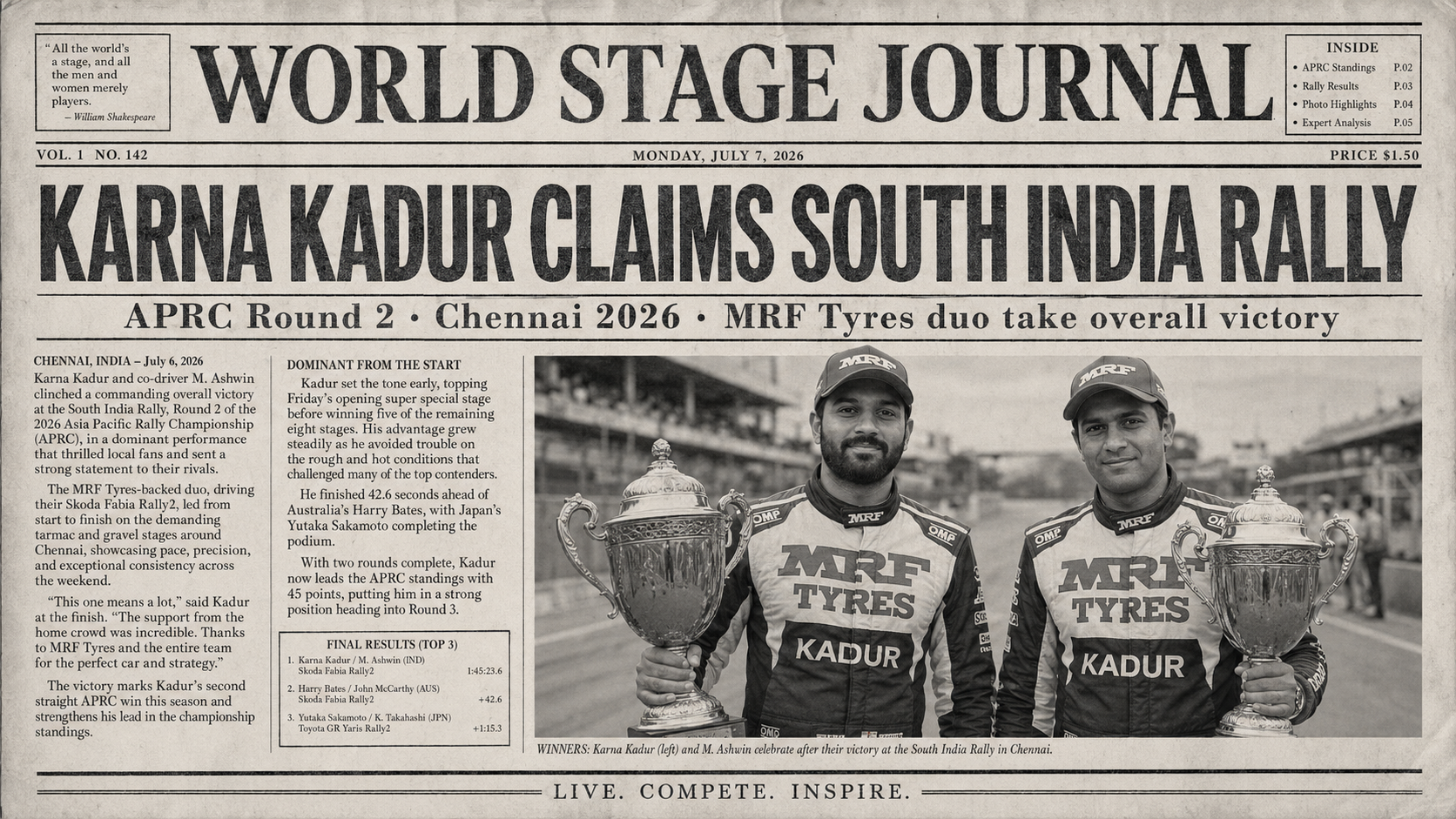
APRC Ronda 2 — Kadur se beneficia del abandono de Gill para ganar el 49.º South India Rally en el calor de Chennai
El 49.º South India Rally, celebrado del 17 al 19 de abril en el Madras International Circuit a las …