He Kept Going With a Broken Turbo — Karna Kadur Wins the 49th South India Rally | World Stage Journal
RALLY🇮🇳2026-05-01
He Kept Going With a Broken Turbo — Karna Kadur Wins the 49th South India Rally

World Stage Journal
APRC Round 2, May 1, 2026. Time 1:59:55.5 — as Gaurav Gill retired on the same stage, India's young crew delivered a comeback win
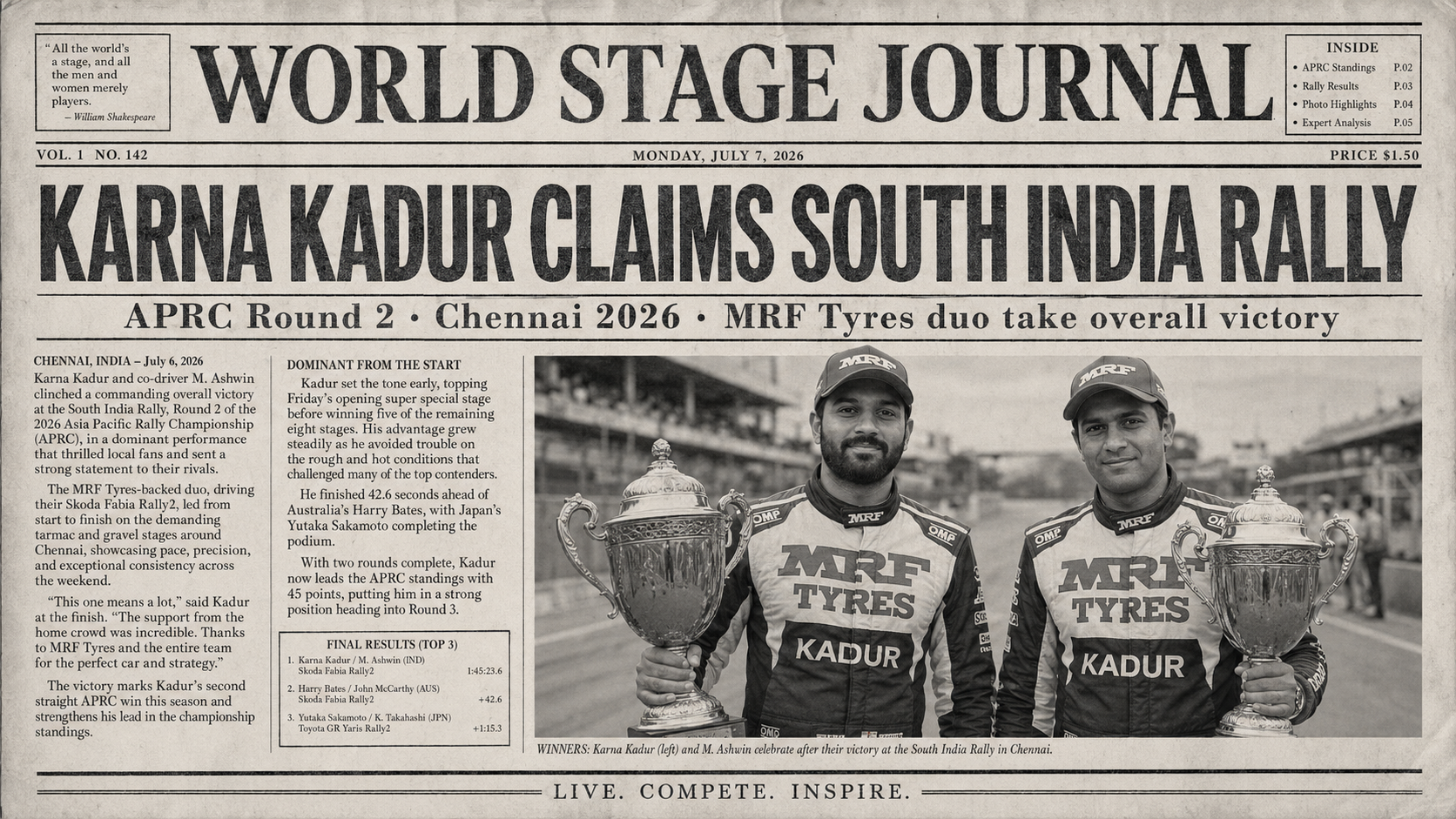
The turbo failed without warning. Power dropped sharply mid-stage and cost the crew well over a minute — a deficit that would have ended most crews' hopes. Yet Karna Kadur and Kumar Ramaswamy (Arka Motorsport) did not stop. At the 49th South India Rally — APRC Round 2, May 1, 2026 — they crossed the line in 1:59:55.5. On that same troubled stage, three-time APRC champion Gaurav Gill retired with a mechanical failure of his own. From disaster to victory in a single afternoon, Kadur took a result that resonated far beyond the results sheet.
The turbo failed without warning. Power dropped sharply mid-stage and cost the crew well over a minute — a deficit most crews would not recover from. Yet Karna Kadur and Kumar Ramaswamy (Arka Motorsport) kept going.
At the 49th South India Rally — APRC Round 2, May 1, 2026 — they crossed the line in 1:59:55.5. On that same troubled stage, three-time APRC champion Gaurav Gill had retired with a mechanical failure of his own. Jeet Jhabakh and Musa Sherif finished second; Edgar Vigo Lopez and Fatima Ameneir of Spain took third.
The decision to keep driving a broken car to the finish line made the difference. Rallying is not a sport that rewards only the fastest.
SUBSCRIBER EXCLUSIVE
Subscriber Only: Deep Dive
■ Chapter 1: What Is the South India Rally? — 49 Editions of History
The South India Rally was founded in 1978, making it one of India's oldest motorsport events. In 2026 it held its 49th edition. The rally is based around Chikmagalur in Karnataka state — a high-altitude coffee-growing region where gravel stages thread through plantations above 1,000 metres. In recent years the event has been incorporated as an official APRC round, transforming it from a domestic competition into an international stage drawing Asia-Pacific's fastest rally crews.
Gravel rally culture is not widespread in India. Sprint events on sealed roads dominate the domestic calendar. Against that backdrop, a gravel-based APRC round in the hills of Karnataka is an anomaly — and a significant one. The South India Rally gives Indian fans something they rarely see: a proper gravel rally on home soil, at a level that connects them to the wider world of international motorsport. The thin air at altitude, the red laterite soil of the plantation roads, the unpredictable hill weather — all of these combine to create a competition environment that exists nowhere else.
Sponsored ColumnDM11 Holdings
This column space is a paid placement for sponsor companies. Exposure across all WSJ articles, distributed in 20 languages worldwide.
■ Chapter 2: The Troubled Stage — How Kadur Decided to Keep Going
The turbo failed mid-stage. There was no gradual degradation — power simply dropped, the characteristic boost pressure of a turbocharged rally engine evaporating without warning. In real terms, losing turbo pressure on a gravel stage means the engine reverts to near-naturally-aspirated output. Traction changes. Braking points change. The relationship between throttle and forward motion becomes unpredictable on loose surface. The oversteer and understeer balance shifts.
Karna Kadur and Kumar Ramaswamy had perhaps a few seconds to assess the situation and decide. They kept going. The time loss was over one minute — an enormous penalty by rally standards. But the car was still moving. In rallying, a moving car that finishes is always superior to a mechanical retirement parked on the stage. Kadur understood this calculus precisely and acted on it without hesitation. The decision was not passive — it was an active choice to adapt to a fundamentally different mechanical situation at speed on a competitive stage.
■ Chapter 3: Gaurav Gill's Retirement — What Happened on the Same Stage
Gaurav Gill is a three-time APRC champion — 2013, 2014, and 2017. He is the most decorated Indian rally driver in the history of the Asia-Pacific series and, in terms of prestige within Indian motorsport, the dominant name in the discipline. On the same special stage where Kadur's turbo failed, Gill suffered a mechanical problem of his own and retired from the event. The precise nature of his failure was not made public, but the outcome was complete: he could not continue.
It would be easy to characterise Kadur's win as fortunate — as though Gill's retirement simply handed him the result. That reading misses the point. Kadur was still running after his turbo failed. He chose to complete the stage. The fact that Gill retired on that stage made the result possible, but Kadur's decision to continue made it real. Rally history is full of moments like this, where survival on a bad day turns out to be more important than pure speed on a good one. The result belongs to both choices: Gill's bad luck, and Kadur's refusal to stop.
■ Chapter 4: Who Is Karna Kadur?
Karna Kadur is a young rally driver from Karnataka, the same southern Indian state that hosts the South India Rally. He comes from a motorsport family and grew up with competition cars as part of daily life. He has competed with Arka Motorsport across domestic and international events, building experience in the gravel disciplines that the APRC demands.
This victory at the South India Rally is the defining result of his career to date. To take the win with a broken turbo, in a reversal against a three-time champion on a stage where that champion also retired — the circumstances could not have been more dramatic. Kadur now sits in an interesting position: known within Asia-Pacific rallying, but still building the international profile that consistent APRC results can bring. Performances at this level are what begin to change that. He is the kind of driver that a developing motorsport culture needs as a reference point for the next generation.
■ Chapter 5: APRC and India — A Structural Shift in Asian Rallying
The Asia-Pacific Rally Championship has historically been dominated by Japanese and Australian talent. Drivers from those countries have claimed the majority of titles and stage wins across the series' history. But the gravitational centre of APRC is shifting. The South India Rally is now an established round. Indian drivers are appearing on podiums. Manufacturer interest in the Indian market — one of the fastest-growing automotive markets in the world, with over 1.4 billion people — creates structural pressure for the championship to develop deeper roots in the subcontinent.
Kadur's 2026 victory should be understood in this context. It is not only a personal achievement. It is evidence that the conditions for Indian competitiveness at the APRC level now exist. A homegrown gravel rally champion is the most powerful recruiting tool any motorsport series can have for the next generation of participants and fans. As the South India Rally reached its 49th edition in 2026, the transition that has been building quietly for years became visible. The 50th edition will be watched differently.
49वीं साउथ इंडिया रैली, 17–19 अप्रैल को चेन्नई के बाहर मद्रास इंटरनेशनल सर्किट में आयोजित, FIA एशिया…