The End of World RX — The Day Rallycross Shifted Its Centre of Gravity to Asia

World Stage Journal
The FIA World Rallycross Championship closed after the 2025 season. The pinnacle shrinks to Euro RX — while a new flame ignites in Jakarta
The FIA World Rallycross Championship ended after the 2025 season, bringing down the curtain on the sport's global flagship series after 12 seasons. From 2026, the FIA European Rallycross Championship takes over as the pinnacle — but the story does not end there. In December of the same year, a new world-level event ignites in Jakarta, Indonesia.
For 12 seasons, the FIA World Rallycross Championship was the sport's global stage. It began in 2014, when Petter Solberg became its first champion and the first driver to win FIA world titles in two different disciplines. It ended in 2025 at the Istanbul finale, where Johan Kristoffersson sealed his 8th world title, the first having come in 2017. From 2026 the top tier passes back to the FIA European Rallycross Championship, Euro RX. And at the end of the year, rallycross heads somewhere it has never raced before: Jakarta.
The FIA announced the reset on 18 September 2025. The top class, RX1, is once again reserved for internal combustion engines, and in 2028 the FIA plans to apply to rallycross the new technical framework being prepared for the top category of the World Rally Championship, seen as the way back to a full world championship. Until then, Europe hosts the elite: six rounds, opening at Biķernieki in Riga on 9–10 May and closing at Lousada in Portugal on 12–13 September. Ireland returns for the first time since the 1990s at Mondello Park on 18–19 July.
Far from shrinking, the field has grown. A grid of 30 RX1 Supercars started in Riga, which the FIA called one of the strongest elite rallycross fields since 2018. Kristoffersson won, leading Kristoffersson Motorsport team-mate Ole Christian Veiby home for a one-two. Norway's Andreas Bakkerud hit back in Hungary to take the points lead, before Kristoffersson reclaimed it at Höljes on 5 July, the Swedish ‘Magic Weekend’ that the FIA ranks among the most celebrated events in the sport. Veiby was second there, and home driver Casper Jansson took his first European Championship podium. “There is a real buzz around rallycross again,” said James Nixon, the FIA's rallycross sporting manager.
Then comes Jakarta. On 5–6 December, the Jakarta International E-Prix Circuit in Ancol, North Jakarta, built for Formula E, will be reshaped into a mixed-surface rallycross track for the first FIA Rallycross World Cup. RX1 cars will race in the classic format of heats, a semi-final and a final, with the FIA working alongside the Indonesian sports and entertainment company SARGA.CO. It is the first time the discipline has come to Southeast Asia, and it will be the only truly global rallycross event of 2026. Jakarta's governor, Pramono Anung, has promised the city's support: “The Jakarta government is committed to fully supporting this event.”
For newcomers, rallycross is motorsport at its most compact: a few laps of a short circuit that switches between asphalt and loose surface, cars side by side from the start, and a longer ‘joker lap’ that every driver must take once per race, keeping the order uncertain until the flag. Europe keeps the championship; Indonesia gets the chance to show how many new fans the format can win. “The future of rallycross is bright,” FIA president Mohammed Ben Sulayem said when the event was announced. In Ancol, that promise will be put to the test.
This column space is a paid placement for sponsor companies. Exposure across all World Stage Journal articles, distributed in 23 languages worldwide.
Inquire About Placement →Share this article
Comments
0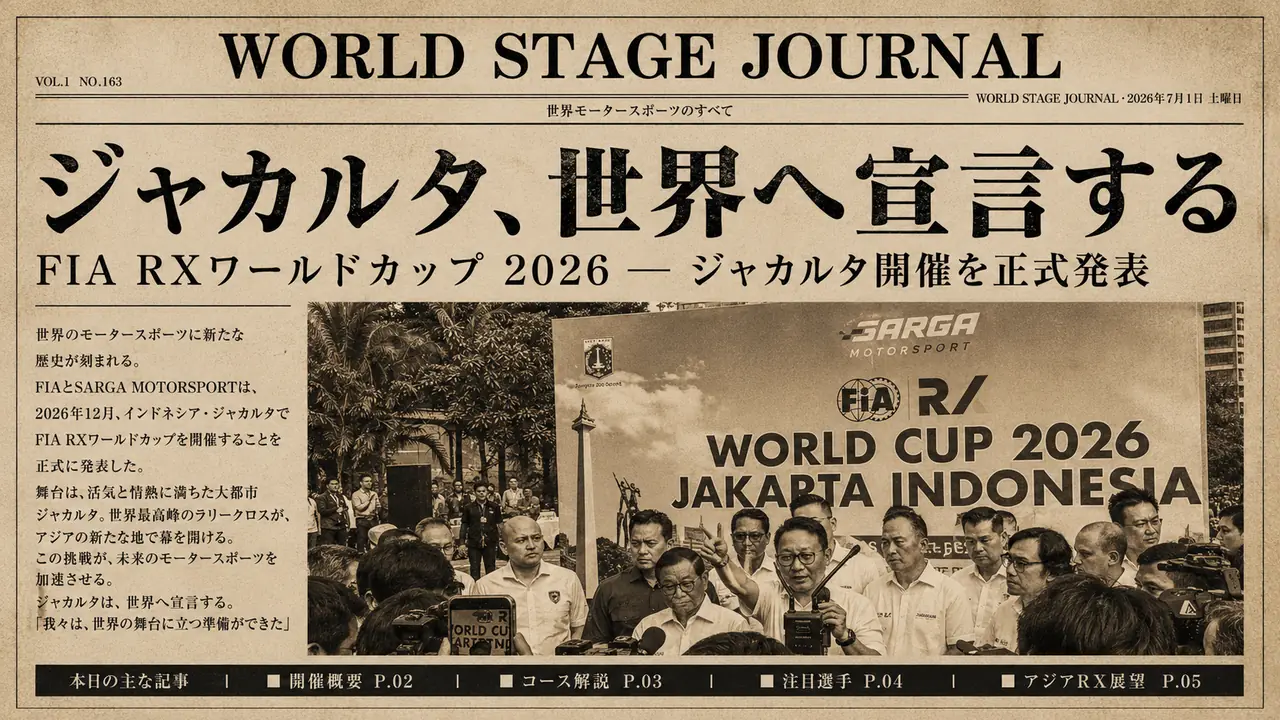
FOUNDING READER
This journal exists because 100 people believed in it before the world did.
Seat #001 could be yours.