Dirt Trial Tire Strategy — Why the Same Surface Demands Different Tires for Different Drivers
Gravel, dry, wet — and the art of reading a surface. Tire choice is not setup. It is driver philosophy.
At any round of the All-Japan Dirt Trial Championship, on the same day, the same course, under the same weather, there will always be drivers in adjacent pits running entirely different tires. The difference is not right or wrong. Tire selection is not part of the setup. It is an expression of how that driver reads a surface — and how they intend to attack it.
Walk through the paddock at a round of the All Japan Dirt Trial Championship and you will find cars from the same class, parked side by side, on different tires. Neither driver has got it wrong. In a discipline where cars tackle the course one at a time, each driver gets two timed runs on a course of around two minutes, and only the faster run counts, the tire decision is made before the clock starts — and once the car leaves the line, there is no changing it.
The ground is the reason. Dirt trial is run on unpaved courses, and JAF Mate, the magazine of Japan's automobile federation, has described surfaces that vary enormously from venue to venue, from clay that turns to mud in the rain to ground so hard it feels almost paved. Within a single event the course keeps changing as well. With well over a hundred cars taking their turn, one heat can take two to three hours, so the surface the first starters meet is not the surface the last starters meet.
How much can change? At Round 5 at Ebisu Circuit in Fukushima in late June, all 10 class winners set their best time on the second run. In PN2, the winner's second run was almost nine seconds quicker than the first: 1:36.720, then 1:27.951. Whatever the course, the driver and the tires were each doing between those two runs, the clock shows how far the picture can move in a single day.
The same results sheet, published by Dunlop, lists the tire brand on every car, and it reads like a two-way tire war. Of the 149 cars on the sheet, 82 ran Dunlop and 65 ran Yokohama. Yokohama-shod cars won 6 of the 10 classes, Dunlop-shod cars 4. At the top of SC, the gap between a winner on Yokohama and a runner-up on Dunlop was 0.026 seconds. JAF itself notes that dirt-specific tires keep evolving, and in a field split this evenly, every step forward matters.
There is one more twist. Under JAF's unified rules for the All Japan gymkhana and dirt trial championships, using equipment or tools to deliberately heat, keep warm or cool tires during the competition is prohibited. No tire warmers, no tricks in the paddock: the rubber reaches its working temperature only by being driven. With a run of around two minutes, that turns the choice of tire and pressure into a genuine prediction of how the car will feel from the very first corner.
So when two drivers in the same class roll up to the start on different tires, it is not a contest between right and wrong. It is two readings of the same ground, two bets placed in the quiet of the paddock — and the clock, down to the thousandth of a second, settles the argument.
This column space is a paid placement for sponsor companies. Exposure across all World Stage Journal articles, distributed in 23 languages worldwide.
Inquire About Placement →Share this article
Comments
0Related Articles
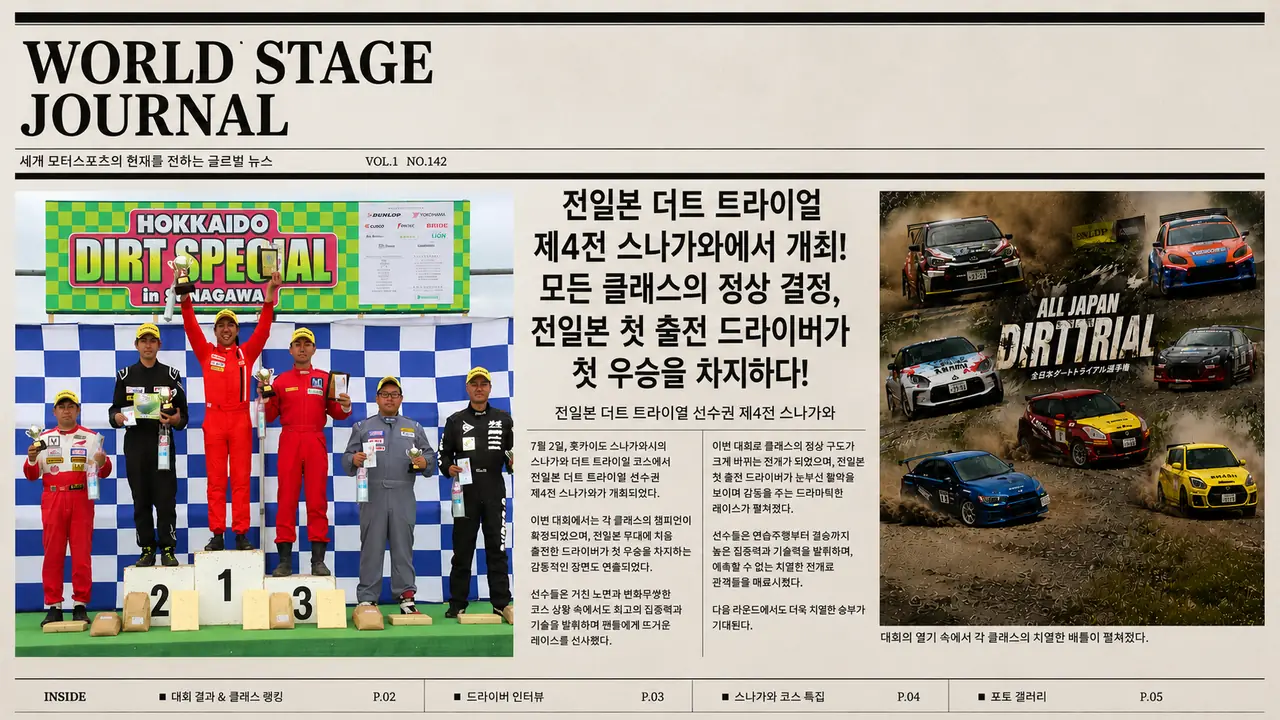
All-Japan Dirt Trial Round 4 Sunagawa — Class Winners Confirmed, Next Stop Ebisu
Round 4 of the 2026 All-Japan Dirt Trial Championship, the Hokkaido Dirt Special in Sunagawa, was he…

David Gravel Claims $300,000 — The Largest Payday in World of Outlaws History at Huset's Speedway
On June 20, 2026, at Huset's Speedway in Brandon, South Dakota, David Gravel of Watertown, Connectic…
FOUNDING READER
This journal exists because 100 people believed in it before the world did.
Seat #001 could be yours.